
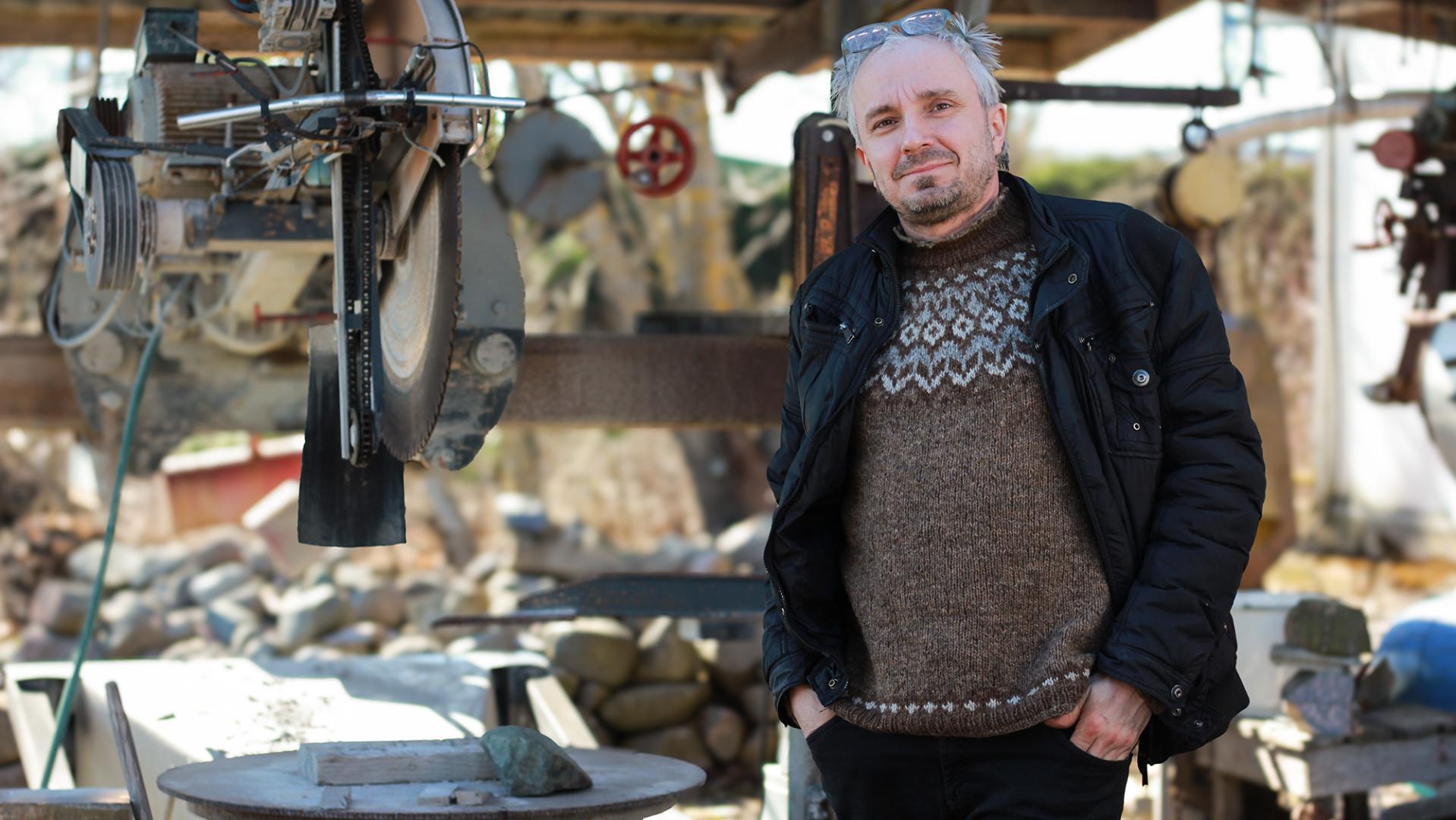
In Ylimarkku, a village in Närpiö, Ostrobothnia, I met Johnny Juthman - a stone artist with a lifelong interest in nature, geological processes and above all the ancient material of stone.
His fascination with the material and his interest in craftsmanship was sparked as early as in his teenage years. To bring his ideas to life, he built his first stone-grinding machine - a simple design, in his own words - to create jewelry. This marked the beginning of a creative process where the material and the machines have always walked side by side. Since then, Juthman has developed his craftsmanship on his own and continued to experiment and invent. Over the years, he has designed over fifty different machines, all custom-built to meet the needs that arise in his creative work.
In 2007, his work with stone truly took off. It began with him grinding stone balls, which later evolved into beads, jewelry, bowls, bottles and candleholders. He describes how the work requires both patience and persistence; creating perfectly round beads took him ten years of trial and error before he found a method that worked. His workshop houses an impressive collection of artworks, where the origin of the material is always present, giving each piece an extra dimension of the earth’s history.
In his work, Juthman primarily uses local stone varieties such as sandstone, porphyry, and granite. Of particular significance is Böle granite, a light gray to reddish stone quarried in Mossberget in Böle, near his home. It has been used in everything from house foundations throughout Ostrobothnia to bridges and monuments. The sandstone comes from the Merenkurkku region and was shaped and transported there by the inland ice, while the porphyry has its origins in volcanic processes.
Out in the yard stand several large machines, all built by Juthman himself and adapted for different stages of the process. Surrounding them are stones of varying sizes, shapes and colors - materials that will eventually be ground into artworks. The processes are time-consuming and consist of many steps from raw stone to finished artwork. First, the stone is cut into a manageable shape, then moved on to the machine best suited for the next step. During the summer months Juthman works mostly outdoors, cutting, grinding, and turning stone, while the winter is spent polishing and refining the surfaces indoors.
Juthman explains how his work with stone differs from, for example, ceramics. While a ceramicist shapes clay into an object, he works in the opposite direction – he grinds away material to reach the form already hidden inside the stone. Even though large parts of the stone are cut away when making, for instance, bowls, no material is wasted. Juthman makes use of all the leftover material and even the tiniest pieces are turned into beads that are tumbled in one of his machines.
The tumbler is powered by wind energy and allows the stones to rotate for several months along with grinding and polishing agents until they achieve their final shape and luster. In an attic space, he shows beads that are currently in the middle of the process. He rolls them between his fingers and notes that they need another month or so in the machine. On the workbench lie porphyry beads that will soon become a bracelet. I get to watch as he drills holes in the beads - even this step, like everything else in his work, is performed using a machine he designed himself.
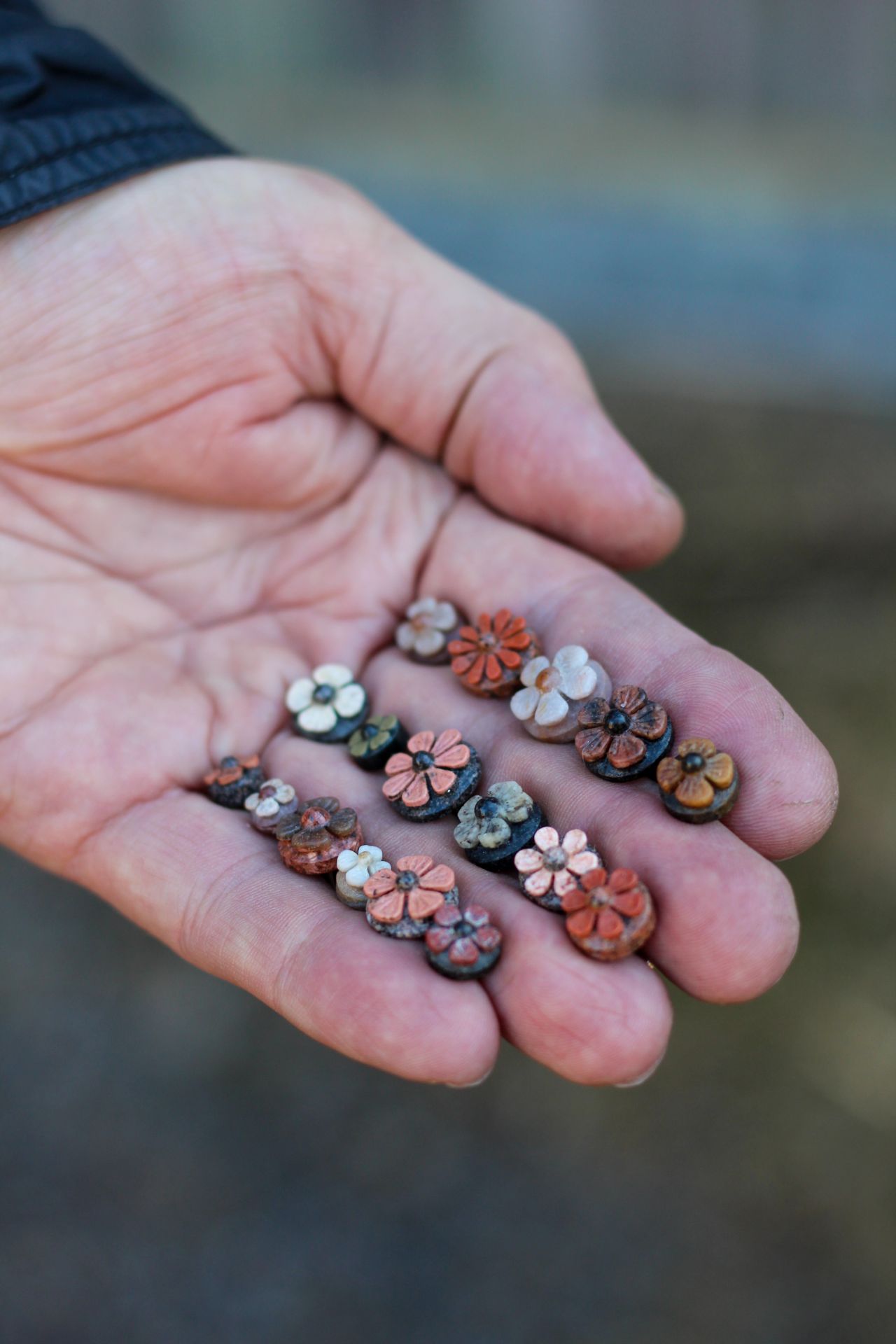
Despite decades of creating, his ideas are far from exhausted. Juthman’s latest creation is a pair of flower-shaped earrings, carved from a single piece of multicolored stone.
He shares that it is his fascination with stone as an ancient material, along with the opportunity to discover new techniques, create new shapes, and constantly challenge himself, that drives him to continue creating.
Right now, it is his work with multicolored stones and mosaic jewelry that brings him the most joy. The mosaic jewelry requires a special precision. Juthman carves an exact shape in a stone and then fits another stone into it, so that the two parts meet without a visible seam.
These pieces are just a taste of what you can see during this year’s Konstrundan. Johnny Juthman looks forward to welcoming visitors to his home - a place where the history of stone, the precision of craftsmanship and his own ingenuity come together. A visit to Juthman in Ylimarkku offers a chance to discover unique art crafted from the ancient Nordic bedrock.